
In response to our callout ahead of Sustainability Fortnight (9–20 November), a number of colleagues have shared projects that are helping to protect the natural environment, reduce waste and improve our understanding of the challenges facing the planet.
Transition Loughborough
Dr Jon Knight, Computer Systems Developer, helps out at local repair café events including supporting the organisation of Transition Loughborough, a community driven movement aimed at reducing the dependence on fossil fuels and promoting local infrastructure in Loughborough.
Repair cafés aim to reduce the number of items that go to landfill by having volunteers offer to try repairing items for free. Jon said: “My usual repair skill is sharpening - I make dull kitchen knives, scissors, garden secateurs, shears and loppers sharp again. Other volunteers sew for garment repair, fix electrical items, perform basic servicing on bicycles, help optimise or replace software on laptops, service sewing machines, and do general hardware repairs (aka ‘screwing-and-gluing’).”
There are also repair cafe events run by Fix It Group 23 taking place in Mountsorrel, with the next one running on 6 December.
How biodiverse is campus? Tracking Loughborough University's insects with DNA
Dr Jon Millett, Reader in Plant Ecology, Daniel Elliott and Dr Dave Graham, Geography technicians, and John Mouseley, local volunteer, have been working on tracking insects on campus with DNA.
Insects underpin healthy ecosystems. They pollinate plants, recycle nutrients and feed birds and bats, yet many insect populations are in decline. To find out how well our campus supports them, the University has been running two Malaise traps (tent-like traps that catch flying insects) for the past three years. One is at the Met Station (opposite the Library), in open parkland and orchard, and the other is in Holywell Wood, an area of ancient semi-natural woodland.
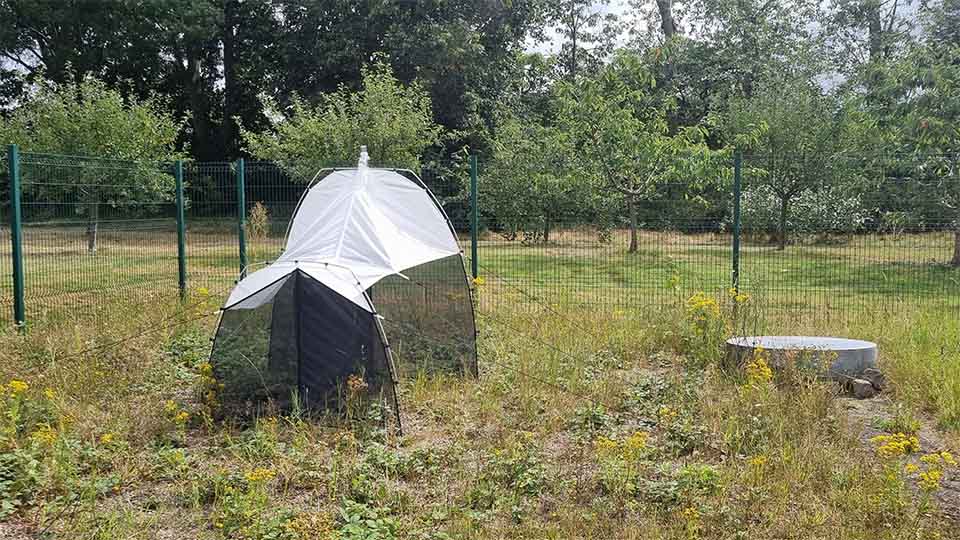
Malaise traps on Loughborough campus
The traps are part of BIOSCAN, a UK-wide project led by the Wellcome Sanger Institute that identifies the insects caught using DNA barcoding. With over 100 BIOSCAN sites across the UK, our campus can be compared directly with sites such as the Natural History Museum's Wildlife Garden and the Royal Botanic Garden Edinburgh. The results suggest the University’s green space is surprisingly good for insects, and the findings are being used to recommend how campus could be managed to support biodiversity further.
Jon said: “Our surveys suggest that there are around 1,800 species in the two habitats where we have traps. Across the whole of campus there will be more, because habitats we haven't trapped, such as those near ponds, will host different species.”
Holt Green Gardeners
Emma Cope, Post Award Project Officer, and Nick Cope, who has worked at the University for over 25 years in various roles within IT, are the driving force behind Holt Green Gardeners, a volunteer group established to improve and maintain the green space on Holt Drive, just a short distance from the University campus.
Since moving to Holt Drive, they have worked with local residents to transform and enhance the community green space for the benefit of residents, dog walkers, families and students living in the area. Their aim is to create an attractive, welcoming and environmentally sustainable space that can be enjoyed by everyone.
Emma said: “Over recent years, we have introduced new planted areas, created bug habitats to encourage wildlife and pollinators, and maintained the grassed areas to ensure they remain accessible for recreation, picnics, informal sport and dog walking.
“We have also introduced a book swap, which Nick built from recycled wood which is extremely well used. The project provides an important green space for both the local community and nearby students, while also increasing biodiversity within the area.”
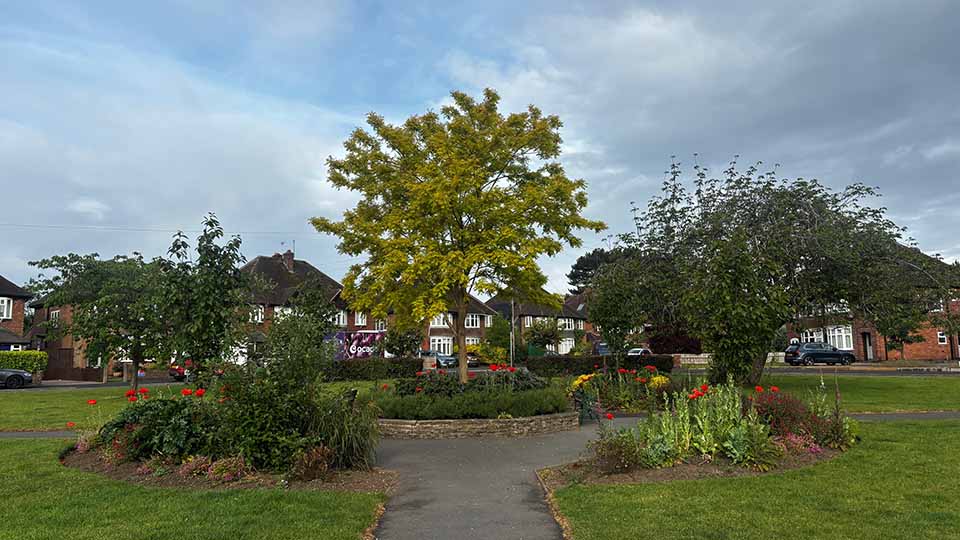
Holt Green’s central flower bed
Their efforts have been recognised through achieving the RHS ‘It’s Your Neighbourhood’ outstanding grading for the last two years. They are currently raising funds for a community noticeboard and a replacement lawn mower to help ensure the long-term sustainability of the project and support greater community engagement.
Emma said: “We both really enjoy being outdoors and a nice outdoor environment is great for people's physical and mental health. If you can do something, however small, to improve your neighbourhood then you should do it.”
Protecting one of Europe's rarest habitats
Dr Jon Millett, Reader in Plant Ecology, Dr Ciara Dwyer, Visiting Fellow in Plant Ecology, and Fanni Tanka and Imogen Onions, Doctoral Researchers, are researching how we can protect sand dunes.
Sand dunes are one of the rarest habitats in Europe and host exceptional biodiversity. Ainsdale Sand Dunes National Nature Reserve, on the Sefton coast, is a prime example. Its dune slacks and the low, seasonally flooded hollows between the dunes support rare plants and animals, including natterjack toads. Dunes also act as a natural sea defence. But they are under pressure from a changing climate, nitrogen pollution and the loss of open, shifting sand.
Loughborough University research at Ainsdale is revealing how these habitats are changing and what it will take to sustain them. It draws on two exceptional long-term records: a 52-year experiment in the dune slacks and a 55-year continuous record of the water table. Together they track how these wetlands respond as the climate shifts, giving conservation managers the evidence they need to protect them.
In 2021, RECOVER began, an experiment that is part of two global research networks, DRAGNet and NutNet, which test how grasslands respond to nutrients, disturbance and grazing. Findings from this experiment feed into a worldwide picture of how grassland biodiversity can be sustained.
Jon said: “Over 50 years we can see that the livestock grazing that is used to maintain the site's nature conservation value is not enough to overcome willow and birch invading the open dune slacks. This matters because sand dune systems are open habitats - rare plants, insects and amphibians depend on open sand and low vegetation. We have also seen that the water table, a key factor affecting the plants on the site, has shifted from varying gradually between years to swinging from extremely wet to extremely dry years. This shift is likely to reduce how resilient the ecosystem is to further climate change.
“Ainsdale National Nature Reserve (NNR) already holds a 50-year experiment and a 55-year record of water table depth. We want to build on these to make Ainsdale a research platform where researchers from a range of disciplines come together to understand the rules that shape biodiversity, and to work out how we can maintain and enhance it in a changing environment.”
These projects demonstrate the many ways our University community is contributing to a more sustainable future. Take part in our Sustainability Fortnight events and discover more about the work taking place across Loughborough and what you could do to make a difference.