
A new study has developed a way to ‘map’ the detailed flow of brushstrokes in paintings in ways that are invisible to the human eye.
The research helps to reveal how an artist’s physical gestures build up effects of movement, atmosphere and emotion on canvas.
Published in the journal Patterns, researchers used AI and image analysis to reveal the underlying direction and flow of brushstrokes across paintings in very different styles.
The result was a series of colourful visual overlays that show the hidden structure of artworks in striking new ways.
It provides art historians, museums and educators with new tools to study and explain the compositional structure of paintings and to better understand different styles of paint handling.
Dr Kathryn Brown, Reader in Art Histories, Markets and Digital Heritage at Loughborough University and co-author of the study, said: “This kind of cross-disciplinary research demonstrates the potential of close collaboration between computer scientists and art historians.
“Creating bespoke AI models can help to open new trajectories in art history, while questions in the humanities also generate new computational challenges.”
For the article published by the team, the researchers developed a computational process called streamline visualisation that transforms tiny local details in the paint surface into flowing lines that reveal how an artist developed the painted surface through gesture and movement.
 Image: Streamlines extracted from Claude Monet’s Haystacks series
Centre: original oil-on-canvas paintings. Surrounding panels: coloured streamlines over grayscale renderings of the same works.
In Monet’s Haystacks paintings, for example, brushstroke flow shifted depending on whether the scene was sunlit, snowy or in shadow, helping researchers to better understand how the artist’s physical use of the paintbrush changed to capture specific atmospheric conditions.
“Brushstrokes are surprisingly difficult to analyse because they are layered, irregular, and deeply tied to colour, texture, and composition.” said James Wang, Distinguished Professor in Informatics and Intelligent Systems at Penn State and co-author of the study. “Computer vision gives us a way to make these subtle patterns more visible.
“By turning brushstroke direction into visual maps, we can study how artists used the movement of the brush to create atmosphere, rhythm, and emotion – without replacing the art-historical judgment that gives those patterns meaning.”
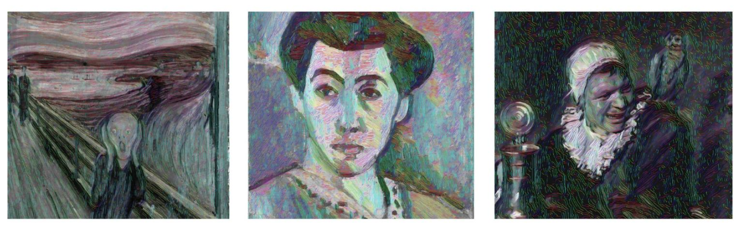
Although the project focused primarily on Impressionist paintings, the researchers demonstrated that the same method could also reveal hidden directional structures in artworks from very different artistic traditions.
Dr Brown added: “It’s an exciting time for art history and computer science. Through this kind of collaborative work, we’re able to create a new way of writing art history that preserves human insight while giving us enhanced data for close visual analysis.”
In addition to Prof Wang and Dr Brown, contributors to this research included Lizhen Zhu (who recently defended her PhD dissertation at Penn State) and Chaewan Chun (current PhD candidate at Penn State).
- Read the full paper: Mapping the flow of painterly gesture
Main image from L-R: The Scream, Edvard Munch, 1893; Portrait of Madame Matisse. The Green Line, Henri Matisse, 1905; Malle Babbe, Frans Hals, 1633–1635
ENDS