Cabinet of Curiosities
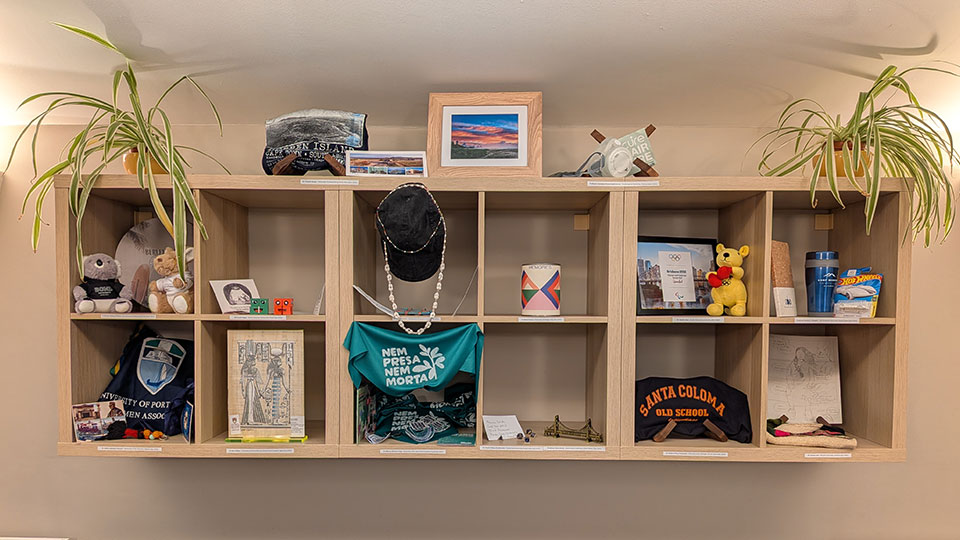
In the 2025-26 academic year, the IAS began inviting longer stay Fellows to bring along an artefact / image along with them when arriving to Loughborough, to help us curate a 'Cabinet of Curiosities' in International House. We are also photographing each section of the cabinet to maintain a digtial archive of these items.
2026-27 Fellows
|
|
|
|
|---|---|---|
|
Dr Alice Ojwang |
Dr Pedro Oliveira October 2026 |
Dr Miss Wangui Maina October 2026 |
|
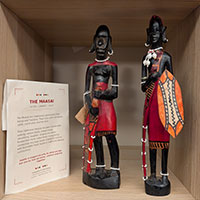
The Maasai are traditionally pastoralists from Kenya and Tanzania. Their lives centre on family, cattle, community and the land. Their traditional lifestyle includes considerable walking, natural foods, shared meals, storytelling, laughter, singing, and dance. Researchers have linked these strong social connections and high levels of physical activity with favourable heart health in traditional Maasai communities. "Health is shaped not only by what we eat, but also by how we move, connect and live together" |
My contribution to the IAS cabinet is a quite emblematic object from my research and practice, serving both a material and a discursive purpose. The cable, sitting alone like it is, offers no explanation about itself except for the possibility of connecting things. In the specific case of this cable I brought – a so-called “banana cable“ which I use to patch my Synthesizer – carries signal but no ground in it. This means that what it connects remains open to interference and crosstalk unless what it connects to is, in itself, grounded. It is also a stackable object: other paths, connections, and routes can be taken from a single point without determining origin or destination. I see my practice as enacting similar gestures: fostering connections without the precondition of a common ground, while not determining a finished trajectory but the possibility of its multiplicity. Relation rather than synthesis, openness and fuzziness instead of finality. |
Artefact forthcoming |
| Professor Sergey Gavrilyuk November 2026 |
Professor Timothy T Clydsedale February 2027 |
Dr Jussi Laine March 2027 |
| Artefact forthcoming | Artefact forthcoming | Artefact forthcoming |
| Professor Helen Peterson April 2027 |
Ms Crystal Bitutu Isanda April 2027 |
Ms Jessica Charlesworth & Professor Tim Parsons May 2027 |
|
Artefact forthcoming |
Artefact forthcoming | Artefact forthcoming |
| Professor Anthony Halog June 2027 |
Professor Jennifer Whyte July 2027 |
Dr Abhilash Panda July 2027 |
| Artefact forthcoming | Artefact forthcoming | Artefact forthcoming |
2025-26 Fellows
The cabinet of Curiosities at the end of the 2025-26 academic year
|
|
|
|
|---|---|---|
|
Dr Sara Shaker |
Dr Bibiana Oliveira Serpa September 2025 |
Dr David William Braithwaite October 2025 |
|
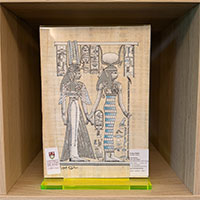
Papyrus painting taken from the tomb of Nefertari is one of the most famous images, Isis leading Nefertari to the afterlife, golden highlights. Nefertiti symbolizes beauty, agency, and divine feminine power. Her name translates to "the beautiful one has come," and her iconic limestone bust remains a global standard of elegance. Beyond aesthetics, she represents supreme authority, religious reform, and the enduring mystique of ancient female leadership. |
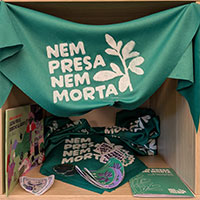
Flags, stickers and leaflets from the Nem Presa Nem Morta campaign, a feminist campaign in Brazil advocating for the decriminalization and legalization of abortion and reproductive justice. |
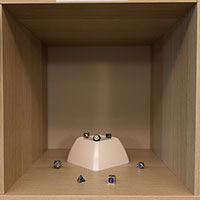
This set of Dungeons & Dragons dice reflect two of my long-standing interests, one personal (D&D, and fantasy in general) and one professional (mathematics). The mathematical angle is that 5 of the dice shapes (all except the 10-sided die) are the five Euclidean solids. It is a fascinating fact, the proof of which is a capstone in Euclid’s elements, that there are exactly five polyhedra whose faces are regular polygons. |
 |
 |
 |
| Dr Andrea Pérez Fernández November 2025 |
Dr Gemma Sou January 2026 |
Dr Mario Panico February 2026 |
| A typical t-shirt of my hometown (Santa Coloma de Gramenet) that alludes to class pride. It became popular when a local dancer who had not formally studied entered a television dance competition. | A "bilum" may look like a simple string bag, but in Papua New Guinea it represents far more than its practical purpose. Handwoven by women using knowledge passed down through generations, bilums carry babies, food, firewood, and the stories that bind families and clans together. Every loop and fibre reflects a living tradition, making the bilum both an everyday essential and a powerful expression of cultural identity. | I chose the “memory tin” by Dutch visual artist Sue Doeksen. The object itself, a tin meant to store and preserve fragments of personal experience, works as a metaphor for what memory scholars do. They collect and assemble pieces to make sense of how the past is remembered. It is also nice to think that future visitors to IAS might want to add their own memories of their time there. |
 |
 |
 |
| Dr Amelia Carr March 2026 |
Sumit Dugar April 2026 |
Dr Ashley Ajumoke Stewart April 2026 |
|
The focus of my research is nutritional and training interventions that can support sport performance, particularly in extreme environments, and for female athletes. The Brisbane 2032 Olympic Games is a current focus for sport and sport science in Australia. This Cabinet of Curiosities contribution includes objects that represent Australia’s aspirations in sport science as we work toward our next home Olympic Games, and the Australian Olympic Team mascot, the Boxing Kangaroo. |
I selected postcards and smiley faces for the cabinet of curiosities because they represent the ‘non serious nature’ of our work in disaster risk management and international development which is full of jargons. So, the postcards puts that in perspective and helps us to recognise our biases and the smiley faces helps us to be grounded as we need to be curious and enthusiastic like children (which I derive from my son Nevaan). | 1. The Purple Messenger Bag: This is a co-produced tie and dye bag from my class- Art and Design Management. 2. University of Port Harcourt Scarf- An important identification material showing belonging with the Women's Association. It is an indication that University of Port Harcourt was present in IAS. 3. 2 Postcards: Although printed in Loughborough, these postcards were my designs emanating from my research in Opobo. It showcases the boat racing and regatta festivals as well as the late Amanyanabo (the King) and the Manila tree demarcating the composition. 4. Denim Apron: Most of my work is entrepreneurial and participatory in nature. This apron I designed for participants of my creative skills workshop which I discussed at my PGR workshop. 5. Keyholder: My daughter Zoe designed the black and orange keyholder and was to present it to the IAS Director. Since she couldn't make it, I added it to the collection. 6. Claypot: The claypot was made in Opobo where we had a youth oriented workshop for mental health and wellbeing. Unfortunately, it broke in transit from Port Harcourt to Lagos and Loughborough. |
 |
 |
 |
| Dr Robert Emmett Alexander May 2026 |
Professor Mark Bevir May 2026 |
Professor Danny O’Brien June 2026 |
| I have a diverse background geographically and personally and figured I should include a few different things to represent such diversity in some way. The shell necklace (Pacific Islands), waist beads (East and Southern Africa) and postcard and small bag (Southeast Asia) reflect where I've done much of my living and working while the cap and caricature of me in that cap with my guitar hopefully remind people of me personally. | The Golden Gate Bridge, with its towers, cables, and span, is the architectural icon of the San Francisco Bay Area. Here it also evokes the way IAS builds bridges among scholars and disciplines. | What's more quintessentially Australian than these Bond University koala and kangaroo mascots? These animals, native to Australia, were an easy choice! The other two items - the tin plate "Burleigh Heads" hanger and the beach image are a bit more personal to me. Burleigh Heads is where I live on the Gold Coast and is only about 10-15min from Bond University. I shot the sunrise image about 200 metres from where I live just a few days before I left to come over here. I surf, walk and spend much of my life in this space and it means very much to me. |
|
|
 |
 |
| Professor Anongnat Somwangthanaroj June 2026 |
Dr Yolandi Burger June 2026 |
Professor Justin A. Haegele July 2026 |
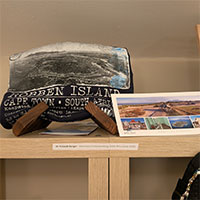
| I chose the T-shirt and postcard from Robben Island because they are everyday graphic objects from a place that carries deep meaning for South Africans and is recognised globally as a UNESCO World Heritage Site. For me, these objects show how memory, place and political history can travel through things that people can hold, wear, keep, personalise and share. |
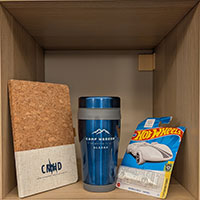
The Center for Movement, Health, & Disability (CMHD) is a research and training center at Old Dominion University focused on movement experiences, health disparities, and community physical activity programs for people with disabilities and chronic health conditions. Camp Webber (formerly Camp Abilities Alaska) is a sports camp in Chugiak, Alaska, for youth who are blind or visually impaired. This is a version of the Twin Mill featuring braille dots all over the body and base. This casting was created in partnership with the National Federation of the Blind and features Braille text on the blister reading "HOT WHEELS TWIN MILL". Braille text on the two sides read "Twin" and "Mill" respectively. The rear of the body reads "#68". The base of the casting simply reads Twin Mill, with Braille text translating to "Hot Wheels" on the base. |